HOW I MET
ZIGGY STARDUST AND SURVIVED
by D A Pennebaker
I was drifting
on a raft on the Mississippi river, filming some friends when I got a message
from my office that RCA wanted to talk to me about a very important project,
to film a half-hour of a David Bowie concert in London, but I had to be
there by the next weekend. It seemed that RCA had invented a new video disc,
called SELECT-A-VISION and I was to make a half-hour film of the Bowie concert
to record on it as a sample of the technology. A half-hour was all they
needed, or could use. A half hour. It seemed a long way to go for such a
short film. With two days to find cameramen and equipment capable of this
sort of filmmaking, I found myself ticketed to London with my eldest daughter,
Stacy, as producer and my friend Jim Desmond, who had almost single-handedly
immortalized Jimi Hendrix at Monterey, as a cameraman. I also managed to
get hold of a young filmmaker, Nick Doob, whose first film I had seen and
liked a lot, Franken, who I knew could shoot a camera but whose work was
virtually unknown to me. There was also the possibility of getting someone
in London with a camera and a tripod. When we finally got to the airport,
we discovered there was an airline strike and hundreds of people were waiting
around for their flights. But there didn't seem to be any planes. As the
night wore on it became clear to me that there weren't going to be any planes,
and that the only things flying were a lot of unreliable rumours. So we
scrounged around and found a bunch of tourists charter-bound for Europe,
whom we fell in with, casually sneaking on their plane, which unfortunately
was bound not for London where we supposed to be the next day but Rome.
When the plane landed the next morning at Fimicino Airport, our tourists
companions were whisked away by bus and we were left surrounded by our camera
bags on the tarmac outside the terminal. Stacy, by now a travel-hardened
producer whispered in my ear. "Dad, why are those men pointing machine
guns at us?" We were indeed being encircled by a number of gun-bearing
officials signaling us to follow them. There had been an assault on the
airport recently and with our surplus army bags filled with cameras we did
not look like the average group of American tourists. In fact I could see
that we looked every bit like a group of unsurgents headed for arrest. In
the terminal it was made clear to me that they were going to put all our
bags through an X-ray machine and if there were any odd looking metal objects
inside we would have to take everything out for examination. Meanwhile,
Stacy got us ticketed on a plane due to leave in about an hour which we
would be lucky to make even without the delay of a thorough search of our
bags. As we paraded our clunky bags past a very professional looking machine
I was astonished to see that there was no sign of alarm, and no flashing
lights signalled any sort of undesirable metal content. As I pushed the
last bag through the X-ray device and hurried to catch our flight, which
was already warming up, I saw the attendant ruefully kick the machine. That's
when I noticed it wasn't plugged in.
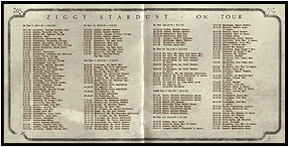
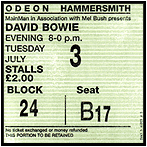
In London we hurried to the Hammersmith Odeon, where the next-to-the-last
concert was about to take place. The following night's concert we were informed
would be the very last concert of Ziggy Stardust and the spiders from mars,
a bit on which we were sworn to secrecy by manager Tony DeFries, who assured
us that only Bowie himself knew this and would reveal it to the audience
sometime during the final performance.
That night we filmed bits of the concert, as well as the audience to check
the lighting. It was an incredibly exciting concert experience, a long way
from the Dylan concerts I had filmed for Don't Look Back. And Bowie himself
was stunning. I have never seen anyone turn on an audience, men as well
as woman, the way he did that night. The minute he strode out on stage I
could see that he was a character looking for a film. Everything was right,
costumes, music, lyrics, makeup, and that spectacular audience. I was struck
by their almost choreographic attention to the songs. They clearly knew
every word to each song and even had their own additions that created a
brilliant interaction between Bowie and the crowd.
So after the show we raced over to a Lab to get our tests processed and
see what was what. The show was almost perfectly lit the way it was, but
the audience was a little dark and I knew they needed to be a huge part
of the film, so early the next morning we watched the crowds of kids gather
outside the theater and I arranged to have signs put up that asked everyone
to bring their flash bulb cameras and take as many pictures as they could.
This illuminated the audience a little more and gave them a constant presence
in the film, so that when when our cameras were turned on Bowie, you could
still feel the crowd with their persistent flashing cameras. Later we would
notice that one of our film magazines was flaking tiny bits of magnesium
onto the film, leaving tiny bits of glitter here and there, which looked
quite beautiful and which we hailed as glitter chrome, our newest contribution
to Glam Rock filmmaking.
When we got back to New York we processed the first half-hour of the concert
for the RCA disc, and tried to figure out a way for David to mix the sound
tracks, which were on a multi-track tape. RCA turned over its gigantic fourth
floor studio and had an engineer at Ampex design a device to match multi-track
audio to the projected film but it didn't work and after a few fruitless
hours of trying to synch up the picture, David gave up and well went back
to our drawing boards. What we finally did was mix down the multi-track
without film and then to lay it into the film take by take. It wasn't easy
but luckily we only had to do it for the half-hour Selectavision disc.
But I really wanted to make a full-length feature out of the concert, and
I needed to figure out how to mix all those bloody tracks, while watching
the film. There was also the problem of how to pay for such an undertaking.
Half-hour films are one thing, and RCA had paid for that, but a two hour
feature film with four track Dolby sound is quite another. I tried to get
hold of David but he'd disappeared into the great Midwest and although I
got occasional calls from small towns suggesting that I fly out and we'd
mix the tracks at a radio station he knew about, I could see that I was
going to have to do it on my own. Firstly, I needed to get the rest of the
film processed, and in a hurry because reversal will turn red if left unprocessed
for too long. I got hold of a friend who worked at the Daily News film lab
which did their TV news film.
We made an arrangement whereby I would deliver so many rolls of film and
some money in a paper bag by way of a bar we both knew of and would pick
up processed film and work print when it was ready.
The film looked beautiful and I began editing, but the sound mix was another
matter. There simply weren't any sound studios that could mix film tracks
the way record companies mixed their records. Film mix studios mixed mono
tracks and they did it very well but here I had sixteen tracks which I had
to bring down to four if I wanted to have the film in Dolby, which after
the success of Monterey I knew was mandatory. The answer was overwhelming
but I was no other way and proceeded to get two studio wires to come in
and another we designed and wired a simple console capable of mixing the
16 original tracks down to a four track master from which I could make a
stereo or four track Dolby sound track. The console took almost six months
to complete but when it was done I was able to mix the whole thing in about
a week. When I put five speakers around my little screening room, which
was about the size of a single car garage, the effect was incredible. I
would have screenings several times a week and it was clear that this was
an amazing film experience. So I got hold of a small portable projector
that could interlock a 16mm film with a stereo track, and started showing
it at places like Yale and Buffalo to a large audience just to see if I
was on the right track. Was I! It was such a success that I could have gone
on the road with that setup and shown that film all over the country. Probably
all over the world.
When ABC heard about it they wanted to run it as a "Movie
of the week". This was big time, so I checked with David and DeFries
who said do it. There turned out though, to be a problem with ABC. They
were nervous about the references to death and suicide that David would
sing about from time to time and requested that I edit them out, which I
reluctantly agreed to do. When I told David about this he suggested that
we beep each of the edits figuring that when ABC heard the effect they might
cancel the edits. So when the network producers heard the annoying beeps
they weren't happy but they were more concerned with their legal liability
so they decided to go with the edited version. I was determined to show
the film with a stereo track which in those days was broadcast on a separate
FM station at the same time as the film was being shown. I arranged with
the FM network and provided a stereo track for the FM channels to run, but
of course I neglected to beep these tracks, so that anyone who heard the
sound on their FM radio heard the true and irreverent Ziggy Stardsut. As
I never heard any complaints from the network I assumed that none of them
ever listened to FM radio. The show was a big hit and letters came in from
all over the country, but it was only a one-time airing.
My dream of getting to a big audience wasn't complete.
I knew that I had to get it into theaters, where the picture would be big
and the sound fantastic. It was the same problem we had with Monterey Pop.
The audience for it was there. We just had to get to them. What I had to
do was make a 35mm theatrical version with my four track Dolby sound and
find a theater to run it. A big theater with really good sound. I received
an invitation to bring some of my work to Edinburgh for their annual film
festival and of course that was it. I knew they had a wonderful theater
there and the film would be considered a sort of avant-garde musical event.
The minute the word of the showing got out, the lid was off. Everyone who
had been at the Odeon or even heard about that eventful concert showed up
and brought two friends, so that evening when I got to the theater expecting
a polite audience of film buffs, there was this incredible theater filled
to overflowing with the very fans that we had filmed. It was a gigantic
deja vu. I couldn't imagine a wilder opening night and I hadn't planned
any of it. I think it was one of the all time great screenings I've ever
sat through, and Chris, my new partner, was there with me - well it's no
exaggeration to say that Edinburgh will always be one of my favorite places
in the world.
Of course word got back to David who called and thereupon
offered to come to New York and remix the tracks so that we could release
the film. But as it happened EMI entered the ring and their quick release
of the video meant no theater release for the film so it all crept under
the sink and up until this moment has been only on VHS, with not very good
sound. Then a few years ago out of the blue, David decided to remix into
the new Dolby 5.1 and release it theatrically as well as on DVD. So now
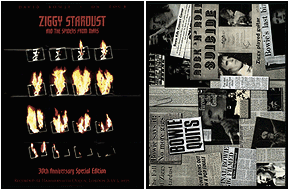
at last after some thirty years Ziggy Stardust gets its day in the sun.
D A Pennebaker 15th June 2002 |